SEO, AEO, and GEO: What B2B Leaders Need to Know in 2026
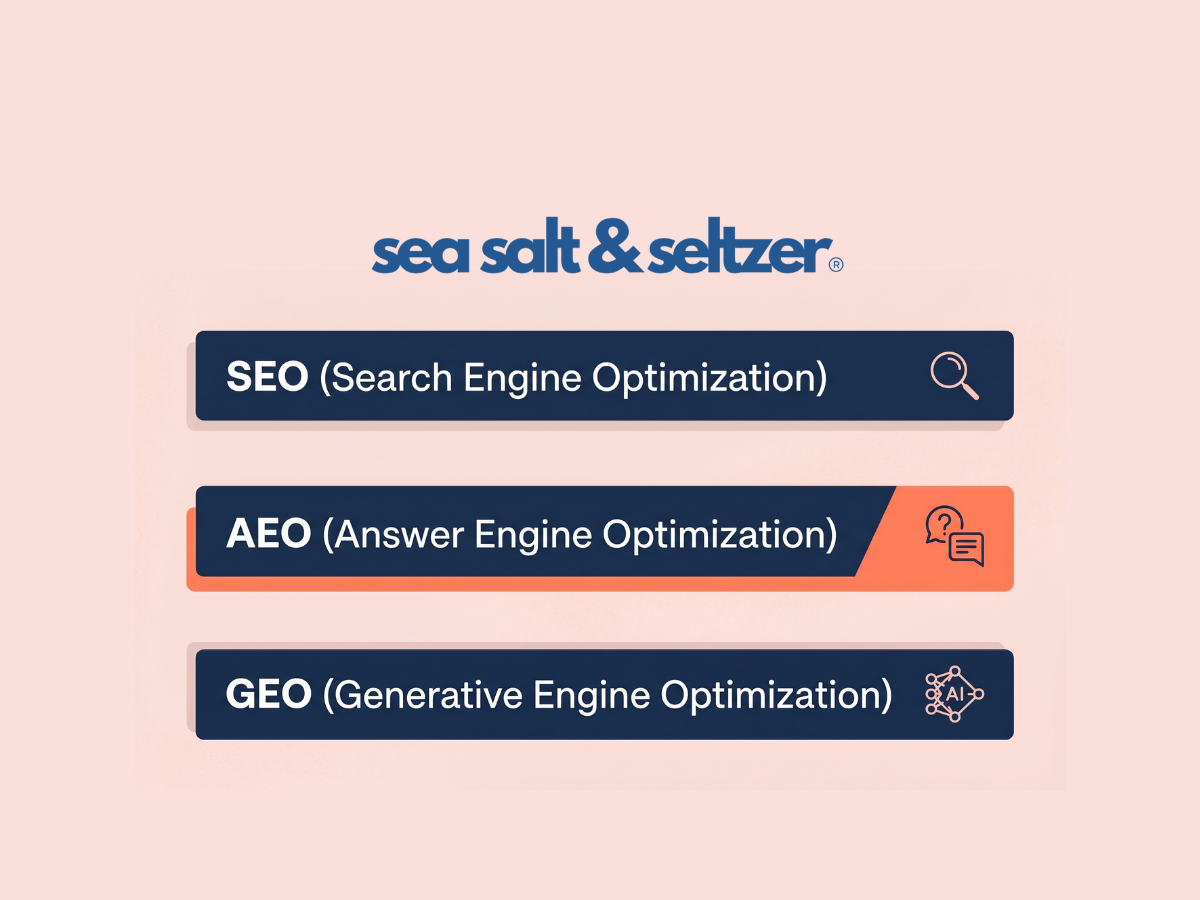
The short version: SEO gets you ranked on Google. AEO gets your content pulled into AI-generated answers. GEO gets your brand cited by ChatGPT and Perplexity. In 2026, you need all three — and the same content discipline serves all of them.
If you've been in a marketing conversation lately, you've probably heard these terms. SEO is familiar. AEO and GEO are newer, and the explanations floating around tend to be either too technical for a non-specialist or too vague to act on. This guide is for B2B leaders who want a plain-language understanding of what each one means, what changed in the last 12 months, and what your marketing strategy needs to account for right now.
You don't need to become a search expert to use this. You need enough context to ask the right questions of your marketing team or agency, and to understand why a content strategy built on clarity is the most durable investment you can make in 2026.
What Is SEO, and Is It Still Worth Your Attention?
SEO, or Search Engine Optimization, is the practice of structuring your website and content so that Google ranks it highly when someone searches for a relevant term. It's been the foundation of B2B content marketing for over a decade, and despite everything that's changed, it still matters.
The mechanics are well established: use the words your buyers search for, structure your pages clearly, earn credibility through links from reputable sites, and make sure your website is technically sound. A company that does these things consistently will show up when a prospect is searching for what they offer.
What's changed is that ranking on Google no longer guarantees visibility the way it used to. An independent study by Joinindexed examining 50 B2B keywords found that 84% of them — 42 out of 50 — now trigger an AI Overview at the top of the page, meaning a significant share of searchers read an AI-generated answer before they ever see the ranked links below it. SEO is still the entry ticket to being found. It's just no longer the whole game.
What Is AEO, and Why Did It Become Important?
AEO stands for Answer Engine Optimization. It describes the practice of structuring your content so that when Google's AI system generates an answer to a search query, it pulls from your page.
This matters because Google's AI Overviews don't always cite the highest-ranking page. They pull from pages whose content is easiest to extract a direct, clear answer from. A well-structured page that answers a question plainly in the first paragraph will often out-earn a higher-ranked page that buries its answer in dense prose.
The practical implication for B2B companies is that the format of your content now matters as much as its depth. Answering the question your buyer is asking, in plain language, early on the page, is what earns you a place in AI-generated answers. This isn't a trick or a technical workaround. It's good, clear writing applied consistently.
What Is GEO, and How Is It Different from AEO?
GEO stands for Generative Engine Optimization. Where AEO is about showing up in Google's AI Overviews, GEO is about being cited by standalone AI tools: ChatGPT, Perplexity, Claude, Gemini.
When someone asks ChatGPT a question about your industry, it constructs an answer from content it has indexed and deems credible. The companies that show up in those answers aren't necessarily the ones with the best SEO. They're the ones whose content is well-sourced, clearly written, and specific enough to be extractable as a reliable answer.
A 2025 academic study from Kumar and Palkhouski (arXiv:2509.10762) analyzed 1,702 citations across Brave, Google AI Overviews, and Perplexity and found that page structure — semantic HTML, metadata, and content freshness — was the factor most strongly associated with AI citation. The implication is that the signals that matter for GEO are the same signals that make content trustworthy to a human reader: specificity, evidence, and clarity.
Third-party validation has emerged as a particularly powerful GEO signal. Muck Rack's May 2026 analysis of 25 million links across ChatGPT, Claude, and Gemini found that earned media accounted for 84% of all AI citations. Content published on your own website is useful, but content that earns coverage elsewhere is what AI systems cite most often.
SEO vs. AEO vs. GEO: A Plain-Language Comparison
| SEO | AEO | GEO | |
|---|---|---|---|
| What it does | Gets you ranked on Google | Gets your content pulled into AI-generated answers | Gets your brand cited by ChatGPT, Perplexity, Gemini |
| Who sees you | People who click search results | People who read AI-generated answers on Google | People who ask AI tools directly |
| What signals matter | Keywords, backlinks, page structure | Direct answers, clear structure, credibility | Named data, citations, clear writing, authority |
| Can you rank #1 and miss this? | N/A | Yes — AI Overviews now pull from a separate track | Yes — LLMs have their own citation logic |
What Changed in 2025 and 2026
The shift from SEO as the primary visibility channel to a three-track system happened faster than most B2B marketing strategies have adjusted for. A few data points are worth understanding:
- Forrester's 2026 State of Business Buying report found that 94% of B2B buyers now use AI in the buying process, and generative AI or conversational search is the single most-cited research source — named by twice as many buyers as any other channel. Your prospects are using AI to research vendors before they ever visit your website.
- Originality.AI's independent study of 29,000 queries found that 52% of pages cited in AI Overviews don't rank in the top 10 organic results at all. Ranking well and being cited by AI are now substantially separate outcomes.
- Pew Research Center tracked 68,879 real searches and found that users clicked a traditional result on just 8% of visits where an AI summary appeared, compared to 15% without one. But being cited inside the AI summary changes the equation: brands that appear in the AI-generated answer earn meaningfully higher click-through rates than those that don't.
- Stacker's March 2026 controlled study found that distributing content across third-party publishers produced a median 239% lift in AI citations across 8 platforms. Distribution to earned channels, not just publishing on your own site, is now a measurable GEO lever.
The practical takeaway for a B2B leader evaluating their marketing strategy: if your content isn't structured for both search and AI visibility, you're leaving a significant share of your potential audience unreached, even if your SEO fundamentals are solid.
Three Things Any B2B Company Can Do This Quarter
1. Audit your most important pages for answer clarity
Pick the five pages on your website that you most want prospects to find: your homepage, your primary service or product pages, and your highest-traffic blog posts. For each one, ask whether a reader who landed there cold could find a plain-language answer to the question that brought them there within the first two paragraphs. If the answer is buried, restructure the page so it leads with the answer and elaborates below. This single change improves SEO, AEO, and GEO simultaneously.
2. Add named, verifiable data to your content
AI systems are significantly more likely to cite content that attributes claims to a verifiable source. Statements like "many companies struggle with this" don't get extracted. Statements like "according to Gartner's May 2026 survey, 45% of B2B buyers used generative AI during a recent purchase" do. If your content currently relies on general observations without named sourcing, adding one or two attributed statistics per major section is one of the highest-leverage changes you can make.
3. Build a simple FAQ section into your key pages
FAQ sections that mirror the questions your buyers ask, phrased the way they'd type them into a search bar or an AI tool, create structured content that both Google and AI systems can extract directly. The evidence on whether FAQ schema markup itself drives AI citation is mixed — a 2026 Ahrefs controlled study found adding schema produced no meaningful citation lift — but the visible on-page Q&A structure does help AI systems identify and extract relevant answers. Four to six questions with clear, direct answers that reference your specific expertise are more useful than a lengthy prose page that circles the topic without directly addressing it.
What This Means If You're Evaluating a Marketing Partner
For mid-market B2B companies, one of the most common conversations right now is whether to build internal marketing capacity or outsource to an agency. Gartner predicts that by 2027, 95% of sellers' research workflows will begin with AI — which means the content your agency produces needs to perform not just in traditional search, but in the AI-driven research phase that now precedes most B2B buying conversations.
A marketing partner that understands all three tracks, and can build content that serves SEO rankings, AEO extraction, and GEO citation simultaneously, is doing meaningfully different work than one focused only on publishing volume or keyword rankings. The question to ask any prospective agency is straightforward: how do you structure content to perform in both traditional search and AI-generated results? If the answer focuses only on keywords and backlinks, the strategy is incomplete for 2026.
The good news is that content built for all three tracks doesn't require more content. It requires clearer content. A well-structured blog post that answers real buyer questions with specific, sourced information will outperform a higher-volume strategy built on generic coverage. For companies weighing the cost of outsourcing against the return, that efficiency matters.
Frequently Asked Questions
What is the difference between SEO and GEO?
SEO is the practice of optimizing your content to rank highly in traditional Google search results. GEO, or Generative Engine Optimization, is the practice of structuring your content so that AI tools like ChatGPT, Perplexity, and Gemini cite it when generating answers to relevant questions. Both matter in 2026, but they operate through different signals. SEO prioritizes keywords, backlinks, and page authority. GEO prioritizes named data, clear structure, and third-party credibility — as documented in Muck Rack's earned media and AI citation research.
Do I need a separate strategy for AEO and GEO?
Not a completely separate strategy, but an adjusted one. Search Engine Journal's analysis of Google's own AI search guidance notes that Google itself frames AEO and GEO as extensions of SEO fundamentals, not replacements for them. The content discipline that earns AEO and GEO visibility — leading with direct answers, citing verifiable sources, writing for clarity rather than length — is the same discipline that makes content genuinely useful to readers. The adjustments are primarily structural: answer-first paragraph formatting, named attribution on key claims, and FAQ sections built around real buyer questions.
Can I rank well on Google but still be invisible to AI?
Yes, and this is increasingly common. Originality.AI's study of 29,000 queries found that 52% of pages cited in AI Overviews don't appear in the top 10 organic results at all, and citation probability drops sharply beyond the top 50. If your content ranks well based on traditional SEO signals but isn't structured for direct-answer extraction, AI systems may cite other pages on the same topic that are more clearly formatted. Conversely, pages that don't rank in the top 10 can still earn AI citations if their content is sufficiently clear and credible.
How important is it to cite sources in B2B blog content?
More important than it was two years ago. The GEO-16 academic study (arXiv:2509.10762) found that page structure and content credibility signals — including verifiable attribution — are among the strongest predictors of AI citation across multiple platforms. Beyond AI citation, named sourcing builds credibility with human readers and signals to search engines that your content is substantive. For B2B content specifically, where the reader is often a decision-maker evaluating your expertise, attributed data is one of the clearest credibility signals available.
Is GEO worth investing in if we're a smaller B2B company?
Yes, particularly because GEO doesn't require domain authority or a large backlink profile the way traditional SEO does. Stacker's research showed that distribution to third-party publishers — not raw domain authority — drove the largest citation lifts. A well-sourced, clearly written page from a smaller company can earn AI citations alongside content from much larger brands, if the clarity and specificity of the answer is superior. For mid-market B2B companies that can't outspend larger competitors on paid search or link building, GEO is one of the most accessible visibility channels available right now.
What's the fastest way to improve our content for AI visibility?
Audit your most important existing pages and restructure them so the first paragraph after each heading directly answers the question the heading raises — in two to four sentences, with a named source where possible. Cloudflare's 2025 crawler analysis documented that AI crawler traffic grew 305% in one year, meaning your pages are being read by AI systems at a scale that didn't exist two years ago. Getting your content structured for that readership — leading with the answer, not building toward it — is the highest-leverage move that serves SEO, AEO, and GEO simultaneously.
The B2B companies that will earn visibility across search and AI in 2026 aren't the ones publishing the most content. They're the ones publishing the clearest content — built around real buyer questions, sourced credibly, and structured so that both humans and AI systems can find the answer without having to dig for it.
If your current content strategy was built primarily around keyword rankings and publishing volume, this is a good moment to revisit it. The fundamentals of good content — clarity, specificity, and genuine usefulness — have always been what works. The difference now is that AI systems are enforcing those fundamentals in a way that makes the quality gap between content strategies much more visible.
Sources
- Forrester. "The State of Business Buying, 2026." — January 2026
- Gartner. "69% of B2B Buyers Turn to Sales Reps to Validate AI-Generated Insights." — May 2026
- Gartner. "67% of B2B Buyers Prefer a Rep-Free Experience." — March 2026
- Pew Research Center. "Google Users Are Less Likely to Click on Links When an AI Summary Appears." — July 2025
- Muck Rack. "What Is AI Reading? May 2026 Edition." — May 2026
- Stacker / Scrunch. "Earned Media Distribution Triples AI Search Visibility." — March 2026
- Originality.AI. "52% of AI Overview Citations Appear in the Top-10 Google Search Results." — 2025
- Kumar & Palkhouski. "AI Answer Engine Citation Behavior: An Empirical Analysis of the GEO-16 Framework." arXiv:2509.10762 — September 2025
- Joinindexed. "How AI Overviews Are Reshaping B2B CTR in 2026." — 2026
- Cloudflare. "From Googlebot to GPTBot: Who's Crawling Your Site in 2025." — 2025
- Search Engine Journal. "Google's New AI Search Guide Calls AEO and GEO 'Still SEO.'" — 2026
Want a content strategy that performs in traditional search and AI-generated results? That's exactly what we build at Sea Salt & Seltzer.